How To Staff Your Farm
Introduction
A season is decided by the people you have in its fourth week. By then it is far too late to start looking.
You do not need a recruiter or an agency contract. You need a number — how many people, in which weeks — a right-to-work check you can show a year later, and an agreement dated before the first shift.
This chapter is about turning interest into a signed crew.
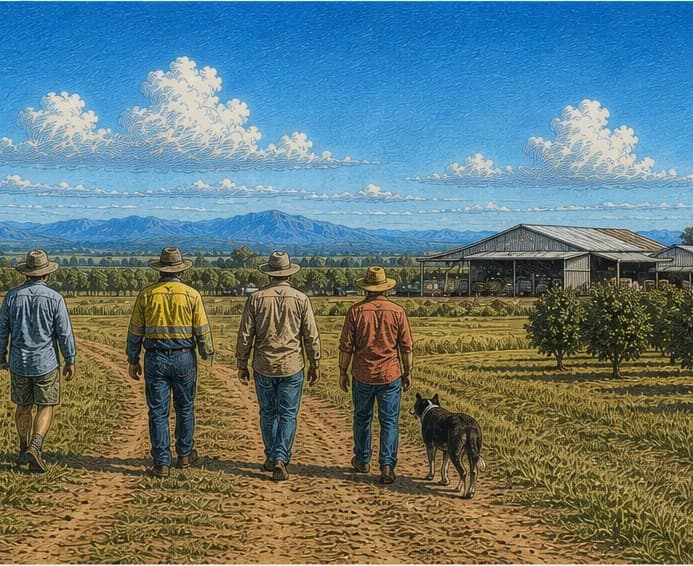
The hiring already happens. Someone rings a hostel on the Tuesday, three backpackers turn up on the Monday, and the paperwork happens later in the week if it happens at all. It works until the week it does not — a worker whose visa does not permit the work they are doing, a rate nobody wrote down, a bank account keyed off a photo taken in a shed, and a first pay run that eats a Sunday.
None of that is a hiring problem in the ordinary sense. It is a sequencing problem: the checks and the agreement arrived after the work instead of before it. Put them in front and each worker costs you about twenty minutes once, rather than an afternoon every fortnight.
Farm work also has a shape no office hiring guide accounts for. The crew arrives for six weeks, half of it has been in the country nine days, a third will leave early for a better rate up the road, and the whole thing has to be right on paper anyway. Nothing here assumes a settled workforce, because most farms do not have one.
Get the order wrong and you pay for it three times over:
- The first morning. A worker who signed before they arrived starts at seven, not at nine after an hour at the office table.
- The pay run. Names, rates, tax declarations and bank details sit in one place, so Friday is a check rather than a hunt.
- The question later. Somebody asks what a worker was promised eighteen months ago, and the file settles it in a minute.
What the Season Actually Needs
The number you need is a different question from the number you can get, and only one of them is yours to decide. What you are after is not a total but a shape: how many people, in which weeks.
The common mistake is to hire a number. Twelve pickers sounds like a plan until the fruit comes on a fortnight early, or the block meant to take five weeks takes three because the heat pushed it. A flat twelve is either idle in week one or short in week three, and both cost money.
So count the work, not the people. Take each block from Chapter I, put a picking window against it, and estimate what one competent person produces in a day — bins, trays, rows, whatever unit the job already uses. Divide the block by the person, spread it across the window, and you have a headcount per week rather than a headcount.
Then add the losses everybody forgets. Some of the people who accept a start date do not arrive, and some of those who do leave inside the first fortnight. Rain takes days out of the window and pushes the same volume into fewer of them. A crew planned with no slack is short every time the weather moves.
A week-by-week plan answers three questions at once:
Where the Crew Comes From
Farm crews come from five places, and each one fails in its own way.
Which one a worker came through tells you what to check hardest, what it costs and how much notice you need. The checks themselves never change, and they are yours whoever supplied the person.
Word of mouth
The best source and the least scalable. Someone who finished last season and brings a mate arrives knowing the blocks and the supervisor, and stays longer than anyone you advertise for. A text in June to everybody who left well in October fills more starts than any advertisement. The limit is arithmetic: it will not build a crew of forty from nothing.
Backpacker hostels
Fast, close and unreliable in both directions. A hostel can fill a start at two days’ notice, but the workers are transient by definition, and some tie a bed to a job or take a cut of the wage. Ask how the hostel is paid; if the answer is a slice of the worker’s pay, look hard before you go near it — that may carry labour-hire obligations for you too.
Labour-hire contractors
You pay a provider, the provider pays the workers, and the workers stand on your ground. Queensland, Victoria, South Australia and the ACT license labour-hire providers, and using an unlicensed one carries penalties for the host farm, not only for the provider. Ask for the licence number and check it on the state register yourself. Ask also what the workers are actually paid — a rate that cannot cover the award plus the provider’s margin is telling you something.
The PALM scheme
Pacific Australia Labour Mobility brings workers from Pacific island countries and Timor-Leste for seasons of several months. It is the steadiest labour on this list and the slowest to arrange: the farm has to become an approved employer, a process measured in months, with obligations for accommodation, welfare and minimum hours attached. Start it a year out, not a fortnight.
Job boards
The widest reach and the coldest leads. A board puts your start date in front of people looking right now, including workers already in the district whose visa runs out in eight weeks. The trade is volume — expect many applications for every person who starts, and expect to answer the same four questions until the advertisement answers them for you.
Write the Job Properly
A job advertisement is a filter, not a shopfront. Written badly it brings you fifty people and none of them right.
Farm advertisements fail in one direction: they leave out what a worker needs in order to say no. Somebody who reads the pay basis, the dates and the lack of a bus, then decides not to apply, has saved you both a phone call. Hiding those things buys applications you filter by hand and starts that do not last a week.
Say all six of these, in the ad, before anyone applies:
- What the work is. Picking mangoes off ladders in November heat is a different job from packing in a shed, and the person who wants one does not want the other.
- When it starts and how long it runs. Dates, even approximate ones. Ongoing reads as we do not know.
- How the pay works. Hourly or piece rate, the employment type, and the classification. A rate you will not print costs you the good applicants.
- Where it is and how to get there. The nearest town, the distance, and whether there is transport to the block.
- Whether there is a bed. Accommodation on farm, or the nearest place there is any, and what it costs a week.
- What they need to bring. Boots, hat, water bottle — and any ticket or licence the job genuinely requires.
Then be honest about the hard parts. Heat, early starts, wet-season humidity, the fact that a rained-out week is a short pay. Workers talk across a district in a day and a half, and an advertisement that oversells is found out faster than one that undersells.
Where the ad lives does as much work as what it says:
Check the Right to Work
Everybody you pay has to have the right to work in Australia, and confirming that is the farm’s job rather than the worker’s.
You do not need a lawyer, a document scanner or a subscription to anything. You need to see one thing per person and record that you saw it: for a citizen or permanent resident, evidence of that status; for everybody else, the visa and its conditions.
Do it on day zero rather than day thirty, because the answer changes what you may do. A visa can permit work with a cap on hours, permit work only for one named employer, or not permit work at all. Finding that out after four weeks of pay runs is a far larger problem than finding it out before the first shift.
Do not accept a photo of a visa grant letter as the check. A letter is out of date the moment it is printed, and it is the easiest document on the list to alter. The status of a visa today is a live fact, and a free government service will tell it to you.
Most farm workers fall into one of four groups:
VEVO answers for one person at one moment. Take the worker’s passport and grant details with their permission, run the check, and save what comes back with the date and the name of whoever ran it. A saved result in a folder is a record; a supervisor saying I had a look at it is not.
Then diarise the expiry. A visa that runs out mid-season is the most common way a farm ends up paying somebody no longer permitted to work, and it is entirely predictable — the date sat on the check you ran in July. Re-check anybody whose visa changes, and any student between semesters.
The obligation sits with the employer under the migration law, and a middleman does not take it away. If a provider tells you the checks are done, ask to see them. If a worker tells you it is fine, run the check anyway. It costs a minute, and it is the only version of the answer you can put in front of anybody later.
The Agreement Comes First
A worker who starts on Monday and signs on Thursday worked three days on nobody’s terms. Not yours, not theirs — nobody’s.
You do not need a bespoke contract for every worker, a solicitor on retainer or a folder of signed originals. You need the handful of facts that decide what a person is owed, written down where both of you can read them, and dated before the work starts.
Which facts? Employment type first, because everything else hangs off it. A casual is engaged shift by shift and paid a loading — 25% under the Horticulture Award — in place of leave and notice. A part-timer has agreed hours and accrues leave. Getting that wrong changes the rate, the entitlements and the ending.
Then classification and rate. MA000028 sets a minimum for each classification level, the level follows what the person actually does, and the rate you write has to sit at or above that floor on the day the work happens. Award rates move each July, so a rate written in March and never revisited is the most ordinary way a farm underpays somebody without meaning to.
Settle these before the worker starts, in this order:
- Employment type. Casual, part-time or full-time, written as one of those words rather than implied by the roster.
- Classification and rate. The level under the award, the hourly amount, and the casual loading where it applies.
- Hours and pay cycle. When they work, when they are paid, and by what means the money reaches them.
- The information statements. Every new employee gets the Fair Work Information Statement; every casual gets the Casual Employment Information Statement too.
- Workplace rules. The site rules, the reporting line, and anything else the worker agrees to by turning up on Monday.
Then have them sign it, and keep what they signed rather than what you would write today. If you change your standard terms in September, the worker who started in July agreed to the July words, and the record has to say so a year later.
Be plain about what such a form is. Any employment form is a starting point your farm reads, changes and adopts as its own document. Not legal advice — review with your own adviser before you send it to a worker. The terms are yours, and the agreement is between your farm and the person you hire.
The paperwork can travel ahead of the worker:
What to Collect, and What Not To
A worker hands over their tax file number and their bank details because you asked, not because they weighed it up.
Every extra field is something you now have to store, secure and eventually destroy. Farms accumulate passport copies in desk drawers and photographs of bank cards in phone galleries because it was quicker at the time, and the copies outlive the worker by years.
The list that earns its place is short:
- Identity and contact. Legal name as it appears on their documents, date of birth, address, phone and email.
- Emergency contact. A name and a number that works. This is the field you will be glad of exactly once.
- Right-to-work evidence. The check result and the date you ran it, plus the visa expiry where there is one.
- Tax and super. The tax file number declaration and the superannuation fund choice — payroll data, and nothing else.
- Bank details. BSB and account number, entered by the worker rather than read off a photograph.
- Tickets and licences. Only the ones the job requires — a forklift licence, a chemical accreditation, a driver licence if they will drive.
Collecting all of it once is also the difference between a worker who feels hired and one who feels processed. Asking the same person for their bank details three times in a fortnight says plenty about how the pay run will go.
Two categories carry a rule of their own:
What not to collect is a shorter list and a firmer one. Medical history the work does not need. Anything about family, religion or relationships. A document photographed into a group chat six supervisors can read. If you cannot name the decision a field feeds, do not ask for it.
Piece Work Needs Its Own Record
An hourly worker and a piece worker can stand in the same row all day and be owed under two different documents.
The hourly agreement covers the person. The piecework record covers the task, and the Horticulture Award treats it as a separate document: it names the task, the unit, the rate per unit, and it is agreed in writing before the piecework starts. It is signed before that morning, not on it.
The rate is where farms come unstuck, and the rule is arithmetic rather than judgement. Under MA000028 a piece rate has to be set so that an average competent worker doing that task earns at least 15% more than the minimum hourly rate for their classification. Not the fastest picker on the crew — the average competent one.
That 15% governs how the rate is designed, not what is paid afterwards. It is also the reason a piece rate is worth setting at all: it should let a good worker earn more than the clock would give them, and it should let you plan a cost per bin instead of a cost per hour.
Work the rate backwards from a timed hour:
Then check the daily guarantee, which is a separate test and uses the plain minimum rather than the 15% target. A pieceworker under the award still has to receive at least the minimum hourly rate for their classification, for the hours they actually work each day. On that $23 bin, a picker managing 1.2 bins an hour earns $27.60, which is short of $32. The difference is a top-up, it belongs in that pay run, and it is not something to settle at the end of the season.
A piece rate is only as good as the counting underneath it. Record the pieces per worker per day, beside the hours that worker spent on the task, or you cannot answer either question — whether the rate was set right, and whether that day cleared the daily guarantee.
Set a different rate for ground that picks differently. A four-year-old block and a fifteen-year-old block do not yield the same bins an hour, and one rate across both short-changes whoever draws the young trees. That is why the two are separate blocks.
The piecework record is your farm’s document as well: not legal advice — review with your own adviser, and read the current award wording rather than a rate sheet somebody printed last season.
The First Morning
The first morning decides whether a worker is still there in week three.
It is also the last cheap moment to fix anything. Somebody shown the water, the toilets, the shade and the person to tell when something goes wrong behaves differently all season from somebody pointed at a row and left there.
A first morning that works runs in this order:
- Confirm who has arrived. Match the person in front of you to the agreement you already hold. If there is no agreement, they do not start.
- Walk the site. Toilets, drinking water, shade, the crib area, where to park and where not to drive.
- Name the hazards. The chemicals in use and any re-entry period still running, machinery movements, ladders, snakes, heat.
- Show the first-aid kit. Say who is trained on it, how to report an injury, and to whom.
- Explain how hours are recorded. Where they punch in, what happens at breaks, and what to do the morning they forget.
- Say when they get paid. The day, the cycle, and what the first pay will and will not include.
Then write down that it happened. An induction nobody recorded is, from any distance at all, an induction that did not happen — and the record costs one line: who was inducted, by whom, on what date, covering what.
In the north, start early, build the breaks into the roster instead of leaving them to individual judgement, and say plainly that stopping in the shade is expected rather than a black mark. A picker who works through their first 38-degree day to look keen is a first-aid call by two.
Housing, Transport, Deductions
A bed and a seat on the bus are easy to provide and easy to get wrong, and the mistake is always in the money. Three arrangements, three different sets of rules.
Housing
On-farm accommodation is often the reason a worker takes the job, and it behaves like a tenancy whether or not anybody calls it one. Write down what is provided, what it costs, and what happens to the arrangement when the work ends. Never tie the bed so tightly to the shift that somebody has nowhere to sleep the day they stop working.
Transport
A bus to the block is a real benefit in a district with no public transport. It is also an hour of somebody’s day, so be clear about whether that hour is paid. The answer turns on whether the travel is part of the work or the commute to it, and it is better settled in writing before the first Monday than after the first pay query.
Deductions
This is the tight one. Taking money out of a worker’s pay is lawful only in narrow circumstances: broadly, the worker authorises it in writing, the authorisation states the amount, the deduction is principally for the worker’s benefit, and it is reasonable. One that mainly benefits the farm does not qualify. Check the particular case against the award, the Fair Work Act and your own adviser before you set it up rather than after.
Deductions are also where an otherwise well-run farm draws attention, because they show on every payslip. If you are unsure whether one is allowed, the cheaper answer is usually to charge for the thing separately and leave the pay alone.
When Someone Leaves
Everybody leaves. The only question is whether the record closes cleanly behind them.
Seasonal work ends by design, and half of it ends earlier than designed — a better rate up the road, a visa date, a family reason. Treat every exit as a routine event with a checklist.
Close five things on the last day:
- The final pay. Hours, piece earnings and any top-up, plus accrued annual leave for permanent staff. Casuals do not accrue it — the loading stood in its place.
- The last date. Recorded, so the employment has an end on paper as well as a start.
- The gear. Keys, radios, secateurs, and the accommodation bond if there was one.
- The records. Employee records are kept for seven years under the Fair Work rules, whether the worker stayed a fortnight or a decade.
- The door. A note of whether you would have them back, written while you still remember why.
That last one is not sentiment. A returning worker needs no induction, knows the blocks by name, picks faster in their first week than a new hire does in their third, and costs nothing to find. The farms that fill their crew first are the ones that ended last season well.
The people are now records the season can be run against:
What comes next:
You now have a crew, checked and signed, standing in a block that has a name. What happens from here is hours, rosters, piece counts and the pay run that reads them — which is what Chapter III covers.